


 Canada
 Best Seller
 Thermal Printers
 All PDAs
 All Thermal Labels
If your business handles cash every day, manually counting bills can quickly become repetitive, time-consuming, and prone to human error. A money counter machine automates this process by feeding banknotes through a set of sensors, counting the bills, and, depending on the model, identifying their denominations and checking them for signs of counterfeiting.
A basic bill counter may simply tell you how many notes are in a stack. More advanced machines can calculate the total value of mixed denominations, detect suspicious bills, support multiple currencies, and display the results for both employees and customers.
So, how does a money counter work? In simple terms, the machine uses a feeding mechanism to move bills through sensors at high speed. The sensors collect information about each note, while the machine's software analyzes that information to determine the quantity, denomination, and—in models with counterfeit detection—whether the bill shows characteristics associated with a counterfeit.
What Is a Money Counter Machine?
A money counter machine is an electronic device designed to count paper currency faster and more consistently than manual counting. It is also commonly called a cash counter, bill counter, or money counting machine.
Traditional bill counters are primarily designed to count the number of notes in a stack. For example, if you place 100 $1 bills into the hopper, the machine can quickly confirm that there are 100 bills.
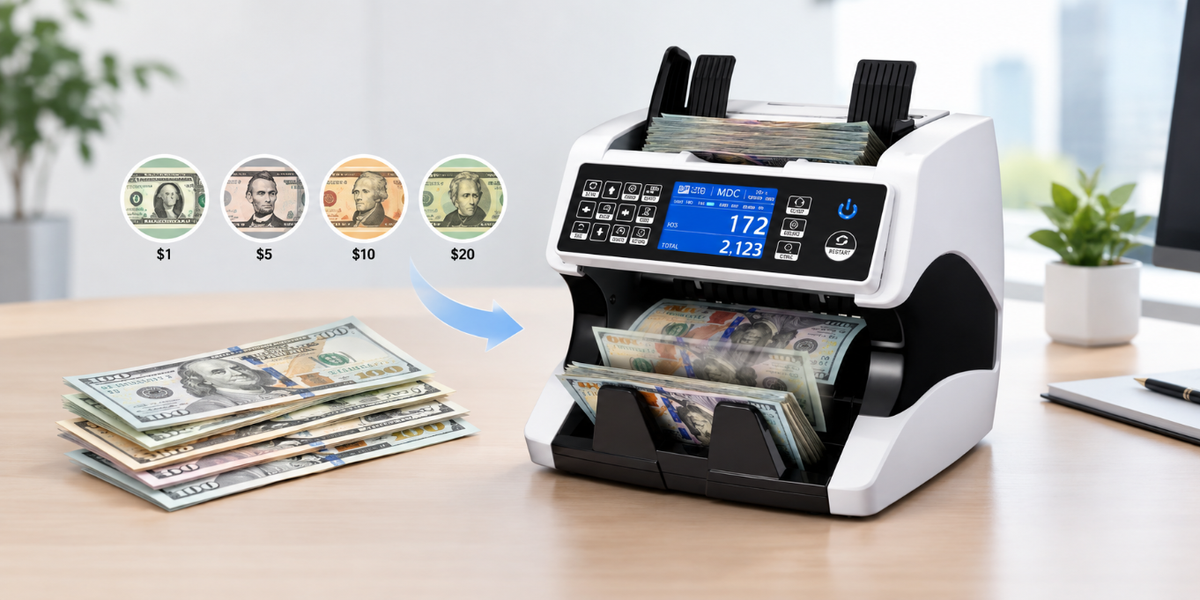
More advanced machines go beyond simple quantity counting. A mixed denomination money counter can recognize different bill values in the same stack and calculate the total monetary value. This means you can place $1, $5, $10, $20, and $100 bills together rather than separating them first.
This distinction is important when choosing a machine. Businesses that only need to count large stacks of the same denomination may only need a standard bill counter. In contrast, retailers, cash-heavy businesses, and other organizations that handle mixed cash may benefit from a value-counting machine.
Explore different options in the MUNBYN Money Counter Machines collection to compare available models and features.
How Does a Money Counter Work?
Most modern money counting machines follow a relatively simple process:
Load bills → Feed bills → Detect each note → Count and analyze → Display results
Although the exact technology varies between models, the main operating steps are similar.
1. Bills Are Loaded Into the Hopper
The counting process starts when you place a stack of banknotes into the machine's hopper. Properly aligning the bills helps the feeding mechanism move them through the machine smoothly.
The hopper holds the notes before they enter the counting path. As the machine starts, rollers separate the bills and feed them through one at a time.
2. The Feeding Mechanism Separates the Bills
Inside the machine, rollers and other mechanical components separate the notes so that they pass through the detection area individually.
This is one reason a money counter can process hundreds or even more than a thousand bills per minute. Instead of requiring an employee to handle every note individually, the machine continuously feeds and analyzes the stack.
The condition and alignment of the bills can affect operation. Folded, damaged, stuck-together, or improperly positioned notes may cause an error or require the machine to stop for inspection.
3. Sensors Examine Each Bill
As each note passes through the machine, sensors collect information about it. Depending on the machine, this may include information related to:
- Bill size and dimensions
- Magnetic properties
- Ultraviolet characteristics
- Infrared characteristics
- Visual or image information
- Other security features used to identify a banknote
Basic counters may use relatively simple counting sensors, while more sophisticated machines combine several detection technologies. For a deeper explanation of UV, MG, IR, and CIS detection, see MUNBYN's guide to money counter counterfeit detection technologies.
4. The Machine Counts the Bills
The machine's sensors determine when individual bills pass through the counting path. The internal processor then keeps track of the number of notes detected.
For example, if 50 bills pass through the machine, the display will show a quantity of 50.
Some machines also offer preset or batch counting modes. These can be useful when employees need to prepare specific quantities of cash, such as batches of 50 or 100 bills.
5. Advanced Machines Identify Denominations
A standard bill counter may only tell you how many notes have been counted. A more advanced machine can identify the denomination of each bill.
This is particularly useful for mixed denomination counting. Instead of manually separating a stack into $1, $5, $10, $20, $50, and $100 bills, a mixed denomination money counter can analyze the notes and calculate their combined value. For example, a stack containing:10 × $1, 5 × $5, 10 × $10, 20 × $20, contains 45 bills with a total value of $515.
A machine capable of mixed-value counting can provide both the bill quantity and total value, significantly reducing the amount of manual sorting required.
How Does Counterfeit Detection Work in a Money Counter?
Counting bills and detecting counterfeit currency are related but different functions. A machine can accurately count 100 notes without necessarily determining whether all 100 notes are genuine. If counterfeit detection is important to your business, you need a money counter equipped with appropriate authentication technologies. Depending on the machine, counterfeit detection may use technologies such as:
UV Detection
Ultraviolet detection checks how a banknote responds to ultraviolet light. Authentic notes often contain security features that produce specific reactions under UV light.
Magnetic Detection
Magnetic sensors can examine magnetic properties associated with certain inks or security features used on banknotes.
Infrared Detection
Infrared sensors analyze how different areas of a banknote interact with infrared light. This can provide another layer of authentication.
CIS or Image Detection
A Contact Image Sensor (CIS) can capture visual information from a banknote. The machine can then analyze the image or characteristics of the note as part of its authentication process. Using multiple detection methods can provide a more comprehensive authentication process than relying on a single sensor.
However, counterfeit detection should not be interpreted as a guarantee that every sophisticated counterfeit will be identified. Businesses should continue to follow appropriate cash-handling procedures and inspect suspicious notes when necessary. If you're deciding between a machine designed primarily for counting and a dedicated counterfeit detector, see Money Counter vs. Standalone Counterfeit Detector.

What Is a Mixed Denomination Money Counter?
A mixed denomination money counter is a money counting machine that can identify different bill values within the same stack and calculate the total value.
This is different from a conventional bill counter, which generally focuses on the number of notes rather than their monetary value. For cash-heavy businesses, mixed denomination counting can save an additional step because employees do not have to sort bills by denomination before counting them.
For example, instead of processing: $1 → $5 → $10 → $20 → $50 → $100
separately, a mixed denomination machine can process the notes together when the supported currency and counting mode are configured correctly.
MUNBYN's IMC22 Mixed Denomination Money Counter is designed around this use case. It supports mixed-denomination counting and uses multiple detection technologies, including CIS, UV, MG, IR, and MT sensors. The machine is also designed to provide both the quantity and value of bills during mixed-value counting. You can see the full specifications and features of the MUNBYN IMC22 Money Counter.
Why Use a Money Counter Machine?
For businesses that handle cash regularly, a money counter can provide several practical benefits.
Faster Cash Counting
Machines can process large quantities of bills much faster than manual counting. This can reduce the time employees spend opening, closing, or reconciling cash drawers.
Greater Counting Consistency
Manual counting can produce errors when employees are tired, distracted, or working through large stacks of cash. Automated counting provides a consistent mechanical process.
Reduced Manual Sorting
Mixed denomination machines can eliminate or reduce the need to separate different bill values before counting.
Additional Counterfeit Screening
Models with UV, magnetic, infrared, CIS, or other authentication technologies can add another layer of protection to cash-handling workflows.
Easier Cash Reconciliation
A machine that provides both quantity and value information can make it easier to compare physical cash with expected totals during daily reconciliation.
Who Needs a Money Counter Machine?
A money counting machine can be useful anywhere employees regularly process significant amounts of paper currency. Common applications include:
- Retail stores
- Restaurants and bars
- Convenience stores
- Banks and financial businesses
- Casinos
- Cash-intensive small businesses
- Market vendors
- Fundraising organizations
- Cash collection services
- Other businesses that regularly reconcile paper currency
The right machine depends on the volume and type of cash being processed. A small business counting occasional stacks of the same denomination may need a different solution from a retailer processing mixed bills throughout the day.
What Should You Look for When Choosing a Money Counter?
Before purchasing a money counter machine, consider the following specifications:
Counting speed: How many bills can the machine process per minute?
Counting modes: Does it support simple counting, batch counting, or mixed denomination counting?
Currency support: Does it support the currencies your business handles?
Counterfeit detection: Which technologies are included—UV, MG, IR, CIS, or other methods?
Hopper and stacker capacity: How many bills can you load and collect at a time?
Display: Is the count easy to read? A dual display can also allow customers or coworkers to see the results.
Bill compatibility: Check the supported bill sizes and thicknesses, particularly if you handle multiple currencies.
Software or currency updates: For machines that identify denominations or use image-based detection, updates can be important when new currency designs are introduced.
For example, the MUNBYN IMC22 combines mixed denomination counting, multiple counterfeit-detection technologies, dual displays, and high-speed counting. MUNBYN states that the IMC22 supports more than 120 currency upgrades and offers lifetime software/currency updates.

Money Counter Machine FAQs
Can a money counter count different denominations together?
It depends on the model. Basic bill counters generally count the number of notes, while mixed denomination money counters can identify different denominations and calculate their combined value.
Does a money counter detect counterfeit bills?
Some models do. Money counters with counterfeit detection may use technologies such as UV, magnetic, infrared, image, or other sensors. However, no automated detection system should be treated as a substitute for appropriate cash-handling procedures.
How fast can a money counter count bills?
Counting speed varies by model. Some machines are designed for several hundred bills per minute, while high-speed commercial models can process more than 1,000 bills per minute. Always check the manufacturer's specifications for the specific machine.
Can a money counter count foreign currency?
Some models support multiple currencies, while others are designed for a specific currency. If your business handles international cash, check the supported currencies and whether software or currency updates are available.
Is a money counter the same as a counterfeit detector?
No. A money counter's primary function is to count bills, while a counterfeit detector is designed primarily to authenticate currency. Some advanced money counters combine both functions, allowing businesses to count and screen bills during the same workflow.
Final Thoughts
A money counter machine combines mechanical bill feeding, electronic sensors, and software processing to automate the counting of paper currency. Basic models focus on bill quantity, while advanced machines can recognize denominations, calculate total value, and perform multiple counterfeit-detection checks.
For businesses that handle cash regularly, understanding the difference between simple bill counting and advanced features such as mixed denomination counting and counterfeit detection is essential when choosing the right machine.
If your operation needs more than simple quantity counting, explore MUNBYN's money counter machines to compare available solutions. For mixed-denomination counting and multi-layer currency detection, the MUNBYN IMC22 provides a more advanced approach to everyday cash handling. (Use the limited-time discount code "MYSEO6" at checkout to enjoy an extra 6% off.)

Share:
How to Make Custom Coffee Cup Stickers at Home?