


 Canada
 Best Seller
 Thermal Printers
 All PDAs
 All Thermal Labels

To count cash quickly, first sort bills by denomination and face them the same direction. Then count in small, fixed groups, bundle every 100 bills, and verify the total. For anything beyond a small stack, a money counter machine is faster and more consistent. Below is a practical guide to both approaches, and how to know when it's time to upgrade.
Quick Answer: The Fastest Way to Count Cash by Hand
- Sort bills by denomination.
- Face all bills the same direction, with the portrait side up.
- Count in small groups (for example, 10 or 20 bills at a time).
- Bundle every 100 bills and note the total.
- Add up your bundles, then recount to confirm.
These five steps cover most situations. The sections below explain how to do each one without losing speed or accuracy.
Why Counting Cash Is Harder Than It Looks
Counting a few bills is easy. Counting hundreds is where things go wrong. Three problems cause most errors:
- Mixed denominations: Switching between $1s, $5s, and $20s while counting invites mistakes.
- Stuck bills: Two notes clinging together are easy to miss, especially with worn bills.
- Interruptions: Losing your place midway through a count often means starting over.
Good technique fixes the first two, and a consistent routine handles the third.
How to Count Cash Quickly by Hand
1. Prepare your workspace
Work at a clean, flat surface with good lighting. Remove distractions, and keep rubber bands, strap bands, and a notepad or calculator within reach.
2. Sort and face the bills
Group bills by denomination first, then turn them so they all face the same way and sit right-side up. This single step removes most of the hesitation that slows a count. Set aside torn, taped, or suspicious bills for separate review.
3. Count in small groups
The human eye is faster and more accurate with small chunks than with a long running count. Many cashiers count by tens or twenties, then stack each group before moving on. Pick one group size and stick with it so your rhythm stays steady.
4. Use the thumb-and-fan technique
Hold the stack in one hand and use your thumb to peel bills off one by one while you count aloud or silently. Fanning the bills slightly helps you spot two notes stuck together. Keep the movement small and consistent rather than rushing.
5. Bundle every 100 bills
Once you reach 100 bills in one denomination, wrap them with a strap or rubber band and write the total on the bundle. This avoids recounting everything if you're interrupted, and it makes the final tally simple.
6. Verify the total
Add your bundles and loose bills, then check the sum against your expected total. For large amounts, ask a second person to recount or use a different method for the second pass, so you don't repeat the same mistake twice.
Common Cash Counting Mistakes to Avoid
- Counting too fast. Speed without rhythm creates skipped or doubled bills. Accuracy comes first.
- Mixing denominations in one pile. Always separate before you count.
- Skipping the second count. A quick recount is cheaper than a shortage.
- Ignoring damaged bills. Torn or glued notes can hide extra bills or cause disputes later.
- Not recording each bundle. Write totals down as you go so a single interruption doesn't cost you the whole count.
Manual Counting vs. a Money Counter Machine
Hand counting works well for small amounts. As volume grows, fatigue and human error grow with it.
|
Factor |
Manual counting |
Money counter machine |
|---|---|---|
|
Best for |
Small stacks, occasional counts |
Daily deposits, large volumes |
|
Speed |
Slows down with volume and fatigue |
Consistent regardless of volume |
|
Accuracy |
Depends on focus and technique |
Consistent, with built-in checks |
|
Mixed denominations |
Must be sorted by hand |
Some models handle mixed bills automatically |
|
Cost |
None |
One-time purchase |
If you count cash every day, such as at a retail counter, restaurant, church, vending business, or market stall, the time saved usually justifies a machine quickly. If you're new to the technology, this explainer on what a money counter machine is and how it works covers the basics.

How a Money Counter Machine Speeds Things Up
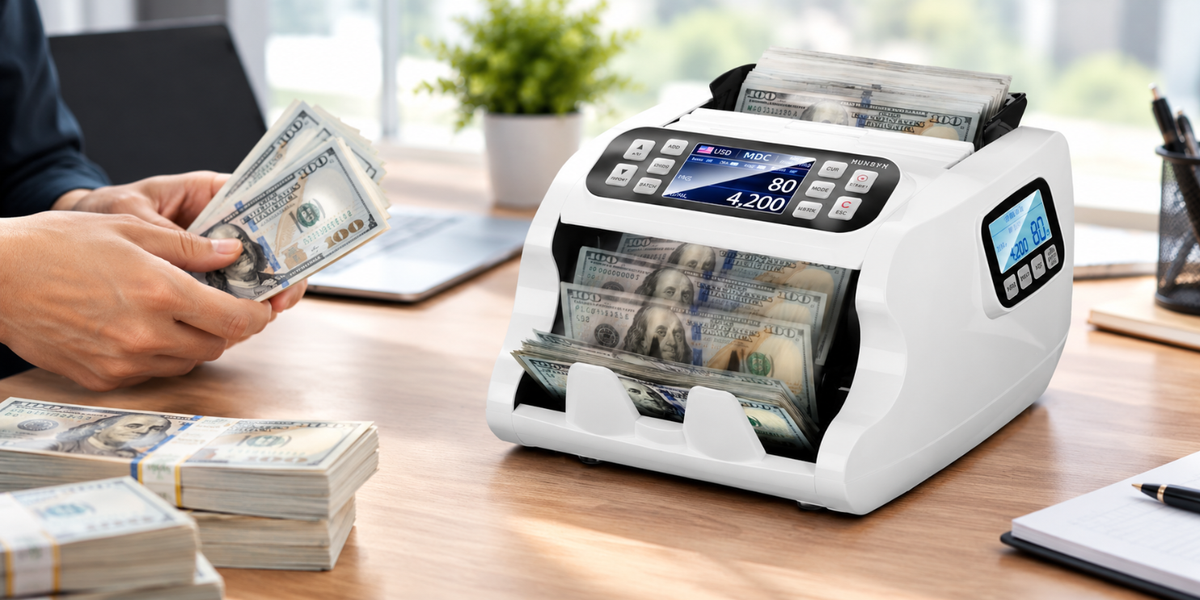
A money counter machine takes a stack of bills, feeds them through, and displays the count automatically. Instead of tracking every bill yourself, you load the stack, press start, and read the result. You still do a quick visual check, but the repetitive work disappears.
Two types are worth knowing:
- Bill counters count the number of notes in a stack. They suit situations where you already sort by denomination.
- Mixed denomination counters calculate the total value of different bills in a single pass, which removes the sorting step. Learn more in this guide to mixed denomination money counters.
If you handle cash from customers, counterfeit protection matters too. This article on UV, MG, IR and CIS counterfeit detection explains what each detection method checks.
A Practical Option: MUNBYN Money Counter Machines
For businesses that want to cut counting time, MUNBYN offers a range of money counter machines for different volumes and budgets.

A good example is the MUNBYN IMC22 Mixed Denomination Money Counter. It is designed to total mixed bills in one run, and its dual display lets you and your customer both see the count. That is helpful at a busy counter or when you need to show a total transparently. Check the product page for the latest specifications, supported currencies, and features before ordering.
How to Choose a Money Counter
Before you buy, think through these points:
- Daily volume: Higher volume calls for faster, more durable machines.
- Denomination mix: If you regularly handle different bills together, choose a mixed denomination model.
- Counterfeit detection: Look for detection that fits the risks in your business.
- Display: A clear, easy-to-read screen reduces misreads, and a dual display helps with customer transparency.
- Currency support: Make sure the model supports the currency you handle.
- Footprint: Counter space is limited in most shops, so a compact design matters.
How to Use a Money Counter Machine
- Place the machine on a flat, stable surface and power it on.
- Straighten the bills and remove any staples, clips, or damaged notes.
- Place the stack in the hopper, facing the direction shown in the manual.
- Choose the counting mode (count only or value, depending on your model).
- Press start and read the total on the display.
- Cross-check against your expected amount, and recount anything that looks off.
Keep the machine clean and free of dust. Bills in poor condition are the most common cause of jams and miscounts.
FAQ
1. What is the fastest way to count cash by hand?
Sort bills by denomination, face them the same way, count in small groups, and bundle every 100. Consistent rhythm matters more than raw speed.
2. How do cashiers count money so fast?
They rely on a routine: sorted bills, small groups, a steady thumb motion, and quick bundling. Practice builds the speed, and accuracy comes first.
3. How can I avoid counting mistakes?
Count in small groups, record each bundle, avoid interruptions, and always do a second count for larger amounts.
4. Is a money counter worth it for a small business?
If you count cash daily or handle mixed bills, yes. It saves time, reduces errors, and can detect counterfeit checks. For occasional small counts, hand counting is usually enough.
5. Can a money counter count mixed bills?
Some can. Mixed denomination models total the value of different bills in one pass, while basic models count only the number of notes.
Final Thoughts
Counting cash quickly comes down to preparation and routine: sort, face, count in small groups, bundle and verify. When volume grows and speed and accuracy matter, a machine such as the MUNBYN IMC22 can take over the repetitive work and give you a number you can trust. Browse the full range of MUNBYN money counters to find the right fit for your business. Use the limited-time discount code "MYSEO" at checkout to enjoy an extra 8% off.

Share:
How to Print Shipping Labels From Your Phone (iPhone & Android)